Your Estate Plan Can Be Perfect and Still Fail
A conversation with Bryan Walley, Co-Founder and CEO of Forward Inheritance
Most estate planning advice assumes the problem is that people have not done the paperwork. That is true, and it is not the whole truth.
There is a second failure, quieter and more common, where the paperwork exists, the intentions are clear, the documents are signed, and the family still cannot execute. I have watched it happen to organized people. It is not a discipline problem. It is a structural one.
On this episode of Death & Dying in the Digital Age, I spoke with Bryan Walley, a repeat founder with more than 25 years in technology and financial technology, who now leads Forward Inheritance. He came to this work the way most of us do, through his own family.
The bird's nest

Bryan's father is a retired litigator. When Bryan finally asked him where the will was, the answer was the one nearly every adult child receives: it's fine.
What arrived was a tangle of documents so disorganized that Bryan asked, half joking, whether there was an eighth amendment to the will. His father said no, that one was on the prenup.
Bryan describes the emotional mix that followed as guilt, embarrassment, and a strange kind of honor. He was standing a half inch taller because he helped run the family now. He also had no idea what to do with what he was holding.
That is the sandwich generation in one scene. You are managing paperwork for your parents, for yourself, and for your children, often in the same week, and nobody helped you with the process.
The mañana problem
Bryan has a name for why this work does not get done. Everyone intends to handle it. Everyone intends to handle it mañana.
He identifies five moments when families actually engage with the state of their estate: a marriage, the birth of a child, a divorce, an unexpected medical crisis, and a death. Nobody can help you with the last one. That one goes to probate, and he is careful to say that probate has a legitimate and necessary function. It is simply the most expensive way to arrive at an answer.
The first four are where the work belongs. His framing has stayed with me: you have to dig the well before you are thirsty.
The national data supports the urgency. According to Trust & Will's 2026 Estate Planning Report, a survey of 5,000 US adults, 56% have no estate planning documents at all. More striking, will ownership fell from 31% to 26% in a single year, even as 73% said estate planning was personally important to them. Awareness is not the constraint. Execution is.
Two overrides most families never see
Here is where the conversation became genuinely useful, because Bryan named two failures that occur after the paperwork is done.
The unfunded trust. After his divorce, Bryan paid several thousand dollars to a well-known firm for a new trust. At the end of the process his attorney told him it was time to fund it. He had no idea what she meant.
Funding a trust means retitling assets into the trust's name. The house. The vehicles. The accounts. Without that step the trust is a well-drafted document that owns nothing, and the assets it was meant to shelter can still land in probate. As Bryan puts it, he does not own his home. His trust owns his home.
A great many people pay for a trust, sign it, file it, and stop there. They believe they are protected. The document says they are. The title records say otherwise.
The beneficiary designation. The form attached to a retirement account or life insurance policy overrides the will. It operates as its own instrument and is settled before a will or trust comes into force.
The scenario is familiar to anyone in this field. Someone names their spouse on a workplace policy. A decade passes. The marriage ends. They remarry. Nobody updates the form. They die, and the proceeds go to the first spouse. The will does not matter. The intention does not matter. The form wins.
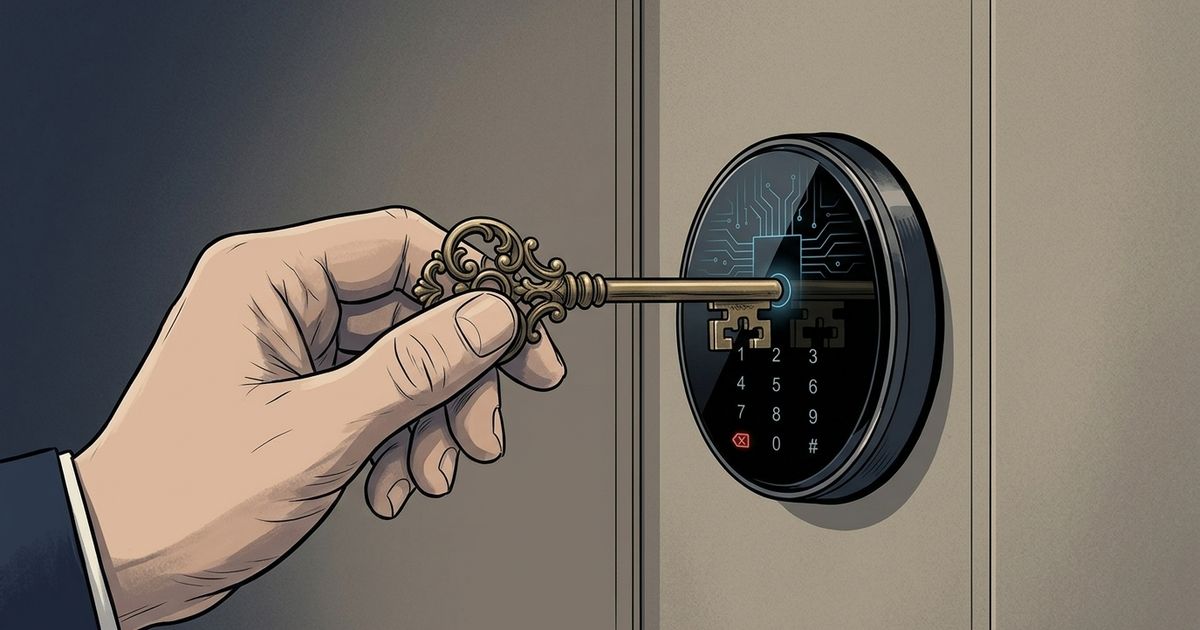
Both failures share a structure. A document you believe is governing is quietly outranked by a mechanism you forgot existed.
The third override, and where I part from the standard advice
That structure has a third instance, and it is the one I want on the record, because it did not come up in our conversation and it belongs to my side of this work rather than Bryan's.
Under the Revised Uniform Fiduciary Access to Digital Assets Act, adopted in some form by the substantial majority of US states, access to your digital accounts is governed by a three-tier hierarchy. At the top sits the platform's own legacy tool. If you configured Google's Inactive Account Manager, Apple's Legacy Contact, or Facebook's legacy contact setting, that instruction controls. It overrides contrary language in your will or trust.
Only if no such tool was used does the law look to your estate documents, and only then to the platform's terms of service.
Read that against the two overrides Bryan described and the pattern is identical. A setting you configured once, possibly years ago, possibly while half paying attention, outranks the document you paid a lawyer to draft.
There is a further complication worth understanding. Federal privacy law, principally the Stored Communications Act, restricts providers from disclosing the contents of electronic communications without lawful consent. RUFADAA is the mechanism that supplies that consent. This is why providers decline family requests that seem obviously reasonable. It is not indifference. It is statutory exposure, and the fix is consent documented in advance, not persuasion after the fact.
Authority is not access
This is the distinction I would add to Bryan's framework, and I think it is the more important half of the problem.
He argues, persuasively, that families should run like businesses. A business that could not account for its assets would be considered failing. A business with disorganized legal paperwork and no governance cadence would be considered failing. Families operate that way as a matter of course, and his proposal of an annual family meeting is genuinely good practice.
But organization solves for authority. It does not solve for access.
I raised this with him through my aunt and uncle, who are in their eighties. Social Security statements, bank records, and financial correspondence used to arrive as paper they could read at the kitchen table. Now everything sits behind a login. They have an iPad and no computer. Passwords are forgotten. Interfaces change without warning. Multi-factor authentication routes a code to a phone one of them may not be holding. Cognitive decline makes each of those obstacles heavier than the last.
A perfectly funded trust does not help if the executor cannot get into the account that holds the asset. A named fiduciary with clear legal authority can still spend months locked out of a cloud drive containing the only copy of a document.
Authority is what the law grants you. Access is whether the door opens. Most planning addresses the first and assumes the second follows. It does not.
Digital resilience, as I use the term, means treating access as its own category of asset. Not what you own, but whether anyone can reach it, under what authority, and through which mechanism.
Three things to do now
Verify your trust is funded. Contact the attorney who drafted it and confirm every intended asset has actually been retitled. Ask specifically about your home, your vehicles, and any account you assumed was covered. This is a records question, not a memory question.
Audit every beneficiary designation. Pull up each retirement account and insurance policy and confirm the name on the form is the name you would choose today. Divorce, remarriage, births, and deaths all create mismatches that the will cannot correct.
Check your platform legacy settings, then align them with your documents. Review the legacy tool on every major account you hold and confirm it names the person you intend. Because these settings can outrank your estate documents, the two need to agree. RUFADAA has been adopted with meaningful state-by-state variation, and some states operate under their own equivalent statutes, so confirm the requirements in your jurisdiction with a qualified estate attorney rather than assuming a national standard applies.
What this is actually for
Bryan closed with a line I keep returning to: automate the mundane so humanity can shine.
The paperwork was never the point. Nobody lies awake grateful they retitled a deed. The reason to clear the administrative layer is that it consumes exactly the weeks a family least has to spare, at exactly the moment they most need to be present with each other.
Your family will inherit two things. What you owned, and whether they can reach it. The first is a legal question. The second is increasingly a technical one, and it is not getting simpler.