Your Will Is a Rudimentary Document
A conversation with Dr. Cory Goldberg, plastic surgeon, longevity physician, and founder of the Form clinic in Toronto
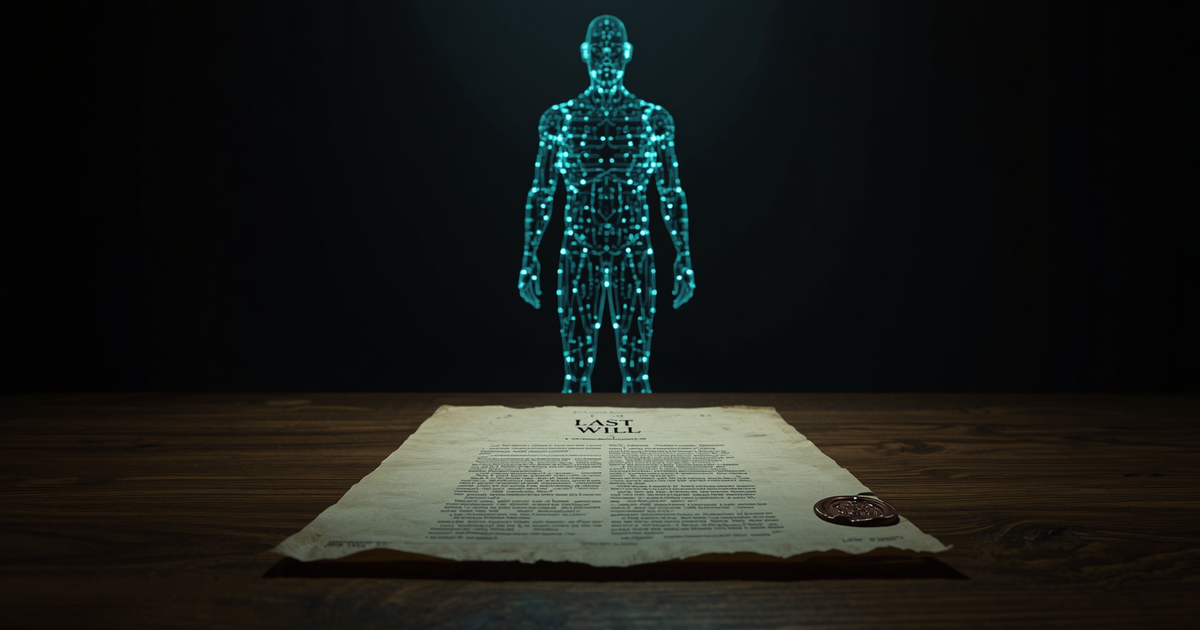
Longevity medicine is quietly building a copy of you. Not a metaphor — a working model, organ by organ, accurate enough to test a treatment on before anyone tries it on your actual body. Nobody in that field has decided what happens to the copy after you die.
I went into this episode expecting to talk about lifespan. We ended up somewhere I did not anticipate: a physician arguing that the legal document at the center of my entire profession is, in his words, rudimentary.
The gap nobody names
Cory came to longevity medicine sideways. He trained as a plastic surgeon in Toronto and practiced aesthetics until his own health changed around 2010 — a fifty-pound weight loss and, more importantly, a shift in how he saw the people walking through his door. He noticed a pattern. The patients coming to him about their appearance were also carrying physical ailments nobody was treating as connected.
That observation moved him from the surface to the whole person, and eventually to a distinction that matters more than most people realize.
Lifespan is how long you are alive. Health span is how long you are well. The two are not moving together, and the gap between them is widening. As a thanatologist I put it more bluntly: we are living longer, but we are also dying longer. Cory does not dispute the framing. His whole argument is that the second number is the one worth fighting for.
"Who in the heck wants to live 150 years in bad health?" he said. "That's a terrible sentence to give. It's something you would wish on your worst enemy."
One in five of us has an organ already failing
Here is the finding that stopped me. Research on proteomics found that roughly twenty percent of people have one organ ageing significantly faster than all their others.
One in five. And that organ is very likely to be the first domino — the thing that starts the cascade putting you among the seventy-five percent of people carrying a chronic disease before sixty-five.
You would not know. Nothing in a standard annual physical is designed to surface it. This is what the digital twin is being built to catch: a biological age calculated organ by organ, from blood biomarkers, epigenetics, body composition, and actual physical testing, so that one failing system becomes visible while there is still time to do something about it.
Cory's clinic is building exactly that, with a predictive layer drawn from twenty years of Mayo Clinic data covering 120,000 patients. The medical case is straightforward. It is the next part that has no map.
The question I actually came to ask
So I asked it. My physical body has an expiration date, whether that is at eighty or a hundred and twenty. What happens to my digital twin when I am gone?
Cory's answer had two halves, and the second one is the one I have not stopped thinking about.
First, the twin is a thing. An asset. It exists, someone owns it, and nobody has settled who. Does it have rights? Do they survive your physical death? Who inherits a functioning model of your body? These are not hypothetical in the way they sound — the models are being built now, and the ownership questions are being deferred rather than answered.
Second — and this is where the conversation turned — the twin is your voice.
What a twin knows that a will cannot
Cory asked me to imagine not building the twin in the year of your death, but starting at twenty. You spend a lifetime telling it things. Your photographs, your experiences, what you thought and why. Once a week it asks you one probing question: is this important to you? What would you want to happen here?
Do that for decades and at the moment of your death you have an entity that holds a genetic representation of your body and a substantial amount of how you actually think.
Then he said the thing that landed hardest:
"A will is a very rudimentary document. You write down on a piece of paper, this is what I want to happen to this and that. How often does that get contested? It's an inert entity. You write that yesterday and a month from now it's changed, but you don't have the chance to go change it."
He is right about the mechanism, and I say that as someone whose work depends on those documents. A will is a snapshot of your intentions on one afternoon, frozen, unable to explain itself. When your family reaches the part you did not anticipate — and there is always a part you did not anticipate — the document cannot help them. It cannot answer a question. It cannot say what you meant.
A twin trained over years could, in principle, do both.
Where I part from the enthusiasm
I said out loud during the recording that this is a Black Mirror episode, and I meant it as more than a joke.
An entity authorised to make decisions on your behalf after your death raises questions the law has not begun to answer. Who verifies that it is representing you rather than whoever controls the platform it runs on? What happens when your family disputes what it says? A contested will goes to probate, which is slow and expensive but has centuries of process behind it. There is no equivalent for a contested twin.
Cory is careful here too. Asked whether consciousness can be downloaded, whether either physical or digital immortality is genuinely coming, he says both are open questions and he is on the fence. That honesty is worth more than certainty.
But I have learned not to dismiss the timeline. In the early nineties someone told me we were going to sequence the human genome. It sounded like science fiction. We now have CRISPR. The pace of change is not linear, and Cory's own assessment is that progress in the last five years has outstripped the prior twenty.
What this means for your plan today
None of this removes the work in front of you. If anything it sharpens why the work matters.
The reason a digital twin sounds appealing is that it would carry context — the why behind your decisions, not just the what. You do not need to wait for the technology to provide that. You can write it down now. The people who will one day act on your behalf need your reasoning far more than they need your instructions, and almost nobody records it.
The ownership question is also already here, in a smaller form. You may not have a digital twin, but you have accounts, photographs, records, and a health history that outlives you. Those are digital assets with the same unanswered question attached: who gets them, who can reach them, and did you say so anywhere your family can find?
And the health-span point stands on its own. One in five people has an organ ageing faster than the rest of them. Knowing which one, early, is the difference between managing something and being managed by it.
The twin may or may not arrive in our lifetime. The plan is available this afternoon.
Live fully, die ready.