Grief and Identity: Who Am I After a Loss?
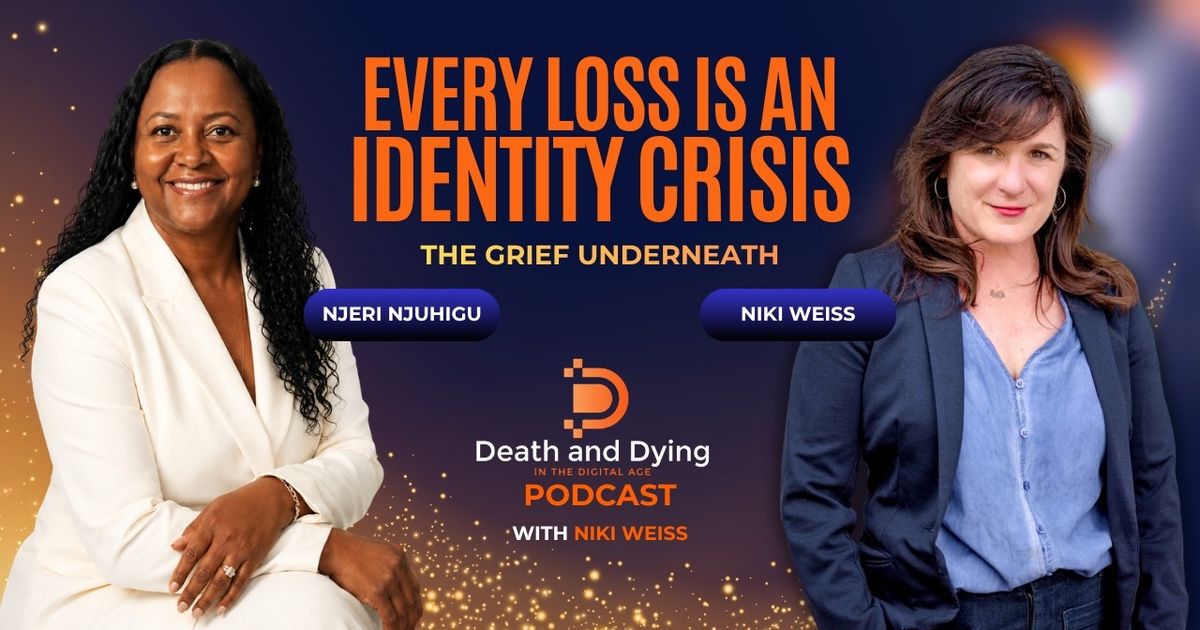
A loss can leave you asking who you are because grief takes more than the person. It also takes the role you played in their life, whether that was wife, son or caregiver, and the version of yourself that existed alongside them.
Njeri Njuhigu, an identity grief and emotional regulation strategist, puts it in one line: “Every major loss is an identity crisis in disguise.”
On this episode of the Digital Legacy Podcast, I spoke with Njeri, whom I met through a community of women who are passionate about AI. I specialize in pre-planning; she works on the grief itself. She spent about 25 years as a TV producer, working as a supervising producer on shows for NBC, Netflix and HBO. For 13 of those years she was also caring for her parents. Her mom had spinocerebellar ataxia, and her mom's husband had pancreatic cancer.
“It was TV, but when I left the office and I went home, I was actually dealing with life and death,” she said. “Because if I didn't do something right, my mom might not wake up in the morning.”
Why does a loss make you question who you are?
Njeri thinks it is the real reason so many of us are afraid of death. “It's not because necessarily the person is dying,” she said, “but who am I when the person dies? Who am I when I stop being a mother? Who am I when I stop being a wife?”
She draws a clear line between the two: “The loss is the event. And the identity crisis is the story we tell ourselves about the event.”
When someone dies, she said, there is “a passing on the other side of the room. When somebody dies, the person left standing also loses a self. The wife isn't the wife anymore.” Her description of what that looks like for a caregiver has stayed with me: “The caregiver who structured four years around one person wakes up on a Tuesday with no role.”
It doesn't take a death. Divorce is a loss. So is losing a job you built your life around, and Njeri sees grief at work, too. If colleagues are being laid off and you suspect you are next, “then I'm already running in the cycle of grief, but we're not calling it grief,” she said. “What people call turnover in a job is actually grief.”
Is putting off end-of-life planning really procrastination?
Not according to Njeri. “It's not really procrastination,” she said. “It's protection.” We avoid planning because it asks us to face something we have not reconciled, and “we're worried about who we are on the other end without recognizing that that's the actual thing that we're afraid of.”
So her first piece of advice is to go easy on yourself. “Give yourself grace because procrastination isn't really procrastination. What it is is protection. It's your brain and your body going in sync to try to protect you.”
I call it a false sense of annihilation: the emotion is so strong you feel you won't survive it. That is why I believe in small, early steps. Take the administrative work off your family's plate ahead of time, and you leave them room for the part nobody can do for them: grieving.
What is anticipatory grief, and what does it do to the body?
Anticipatory grief is grief that starts before the loss, and Njeri was clear that it is not only about death. “It's before someone passes. It's before you lose the job. It's before your child leaves to go to college,” she said. “Whenever you're in anticipation and your body cannot regulate and or adjust to it, you're in anticipatory grief in one form or another.” (We explored the caregiving side of this in grief that arrives before the actual death.)
What the living need, she said, is “an integration of who you were into who you're becoming.” She also wants people to understand that grief is not only emotional. “Grief is actually a physiological experience inside of the body,” she said. When someone we are used to having around is gone, “the body is searching for that person.” That, she said, is why grieving people have brain fog and forget things they never used to forget. And when we don't acknowledge our losses, “throughout our life our griefs are stacking.”
How do you keep someone's memory alive?
Say their name, their full name. Njeri has her clients honor “the life, the love, and the legacy” of the person. For her, that sounds like: “I honor Juanita Miller Parker for the life that she lived and the life that she gave.” The full name matters, she said, because “when we say the name, we conjure all the memories, all the experiences, and all the love.”
Names carry a lot in my tradition, too. In the Jewish tradition, we give the next generation the name of a loved one who has died. I took the A from my mother Arlene's name for my first daughter, Anna, and gave her my mother's Hebrew name. Njeri's own name comes from the Kikuyu people of Kenya and, as she tells it, means “little warrior.”
She also shared a saying: “We die twice, the last breath and then the last time somebody says your name.” Then she added a third passing, the digital one, which is where my work lives. “A digital estate really isn't property,” she said. “It's the photos, it's a voice, it's the thread.” When people go through those things, she sees one of two outcomes: “They either get caught in the time capsule of it,” or “they can create ritual from it.”
Stories are part of that ritual. Njeri grew up hearing family stories around her grandmother's kitchen table. Now she tells them to her nephews, “so that my grandmother, my great grandmother, my grandfather, they never die.” My children know stories about my parents, who died decades ago, for the same reason.
If someone you love is dying, she suggests sharing the stories you love with them while they are here. “You can read a story,” she said, “but to hear someone tell it with the intonation of the voice, the energy of their body, it's a very different experience.”
Can a grief bot help you grieve?
Njeri admits she has “a sordid relationship with grief bots.” If a grief bot “guides a person towards human connection, I'm all for that,” she said. “But often what happens is a grief bot is engineered for continuity, for subscription.” That, she believes, makes grief harder to move through and keeps it circling, in what she calls “the swirl.”
Her deeper point is about readiness. “If I can't deal with it in my human form, I definitely don't want to deal with letting you create a version of the person in the digital form.” I struggle with this too, especially with digital twins: when the human dies, who owns the digital version? For more, see how AI is reshaping grief and my conversation on what happens to your digital twin when you die.
What she expects instead is a turn back toward each other, toward “family community and ritual,” because death is “one of the few times in our lives where we are forced to surrender to the moment.” And there is no getting around it: “Grief is one hundred for a hundred. It never misses.”
Where should you start?
“I think a good place to start is forgiveness,” Njeri said. That reminded me of ho'oponopono, a prayer practice built on four phrases: I'm sorry. Please forgive me. Thank you. I love you. It is a way of saying that we lived the best we could with whatever we were given.
Njeri suggests creating your own forgiveness ritual, and doing it in the mirror “so you can see yourself truly,” because “we're people that wear a thousand masks throughout our day and throughout our lives.”
Her second step is surrender: “Surrender to the moment and be present in the moment with those that you love.” With someone who is dying, that means being with them without making them feel bad about leaving. Her third is the simplest: “Practice the breath because we often are shallow breathing and we are missing the beauty in our lives.”
None of this will stop the grief. Nothing does. But when the paperwork is handled ahead of time, there is more room for the forgiveness, the presence and the stories.
Frequently asked questions
What is identity grief?
It is the grief that runs underneath a loss: losing who you were alongside the person, job or role that is gone. In Njeri Njuhigu's words, “The loss is the event. And the identity crisis is the story we tell ourselves about the event.”
Can you grieve before someone dies?
Yes. That is anticipatory grief. Njeri says it shows up whenever you are anticipating a loss your body cannot yet adjust to, whether that is a terminal diagnosis, a possible layoff or a child leaving for college.
Are grief bots good or bad for grieving?
Njeri's view is that it depends on the design. A grief bot that guides you back toward human connection can help. One engineered for continuity and subscriptions can keep grief circling instead of moving.
Listen and take the next step
Watch my full conversation with Njeri Njuhigu, Every Loss Is an Identity Crisis in Disguise, on the Digital Legacy Podcast. You can find her at livenlight.com.
Planning won't take the grief away, but it can take the paperwork off the table. To see what your family would need from you, and in what order, start here.
Live fully, die ready.
This article is educational and does not provide medical or mental health advice. If grief is affecting your health or daily life, reach out to a doctor or a qualified grief professional.