How to Write a Living Eulogy for Someone You Love
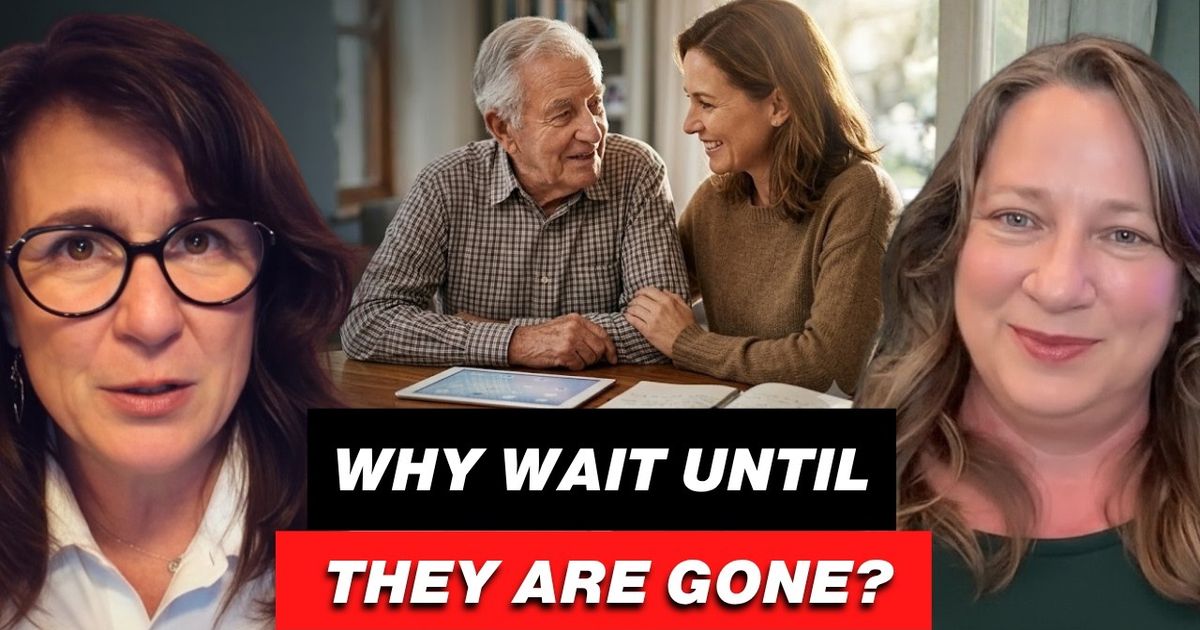
To write a living eulogy, start with stories rather than speechwriting: what the person would want to be remembered for, how they got their nickname, the topics that could keep them talking for hours. Then share it while they are still here to hear it.
That second step is the one that got me. Sasha Stricker's father, who is 80 and doing well, recently asked her to write his eulogy. Not for later. Now. “It led us into a conversation of why do we wait,” she said, “to say all these things until the person is gone?”
On this episode of the Digital Legacy Podcast, I spoke with Sasha, who created TreulogyAI, a guided app that helps grieving families collect their memories and “turn them into a really heartfelt tribute to someone that you love.” She built it after her own family struggled to write one.
Why is writing a eulogy so hard?
Because nobody is ready, and most of us are not writers. When Sasha's father-in-law died years ago, she said, “None of us were prepared. I don't think anyone is.” The hardest part was the eulogy.
He was, in her words, “a colorful little character,” with “very strong opinions about things and the way that things should be done.” The family wanted to honor him “for the person that he was and not sugarcoat any of that.” The draft went back and forth between family members, each adding a part. “It was actually a beautiful process of exploring it, but with the pressure of having to write,” she said, “because I'm not a speechwriter, none of them were speechwriters either.”
The problem, as she put it, “wasn't just collecting the memories, it was trying to figure out how to write them into nice words.”
What questions bring out someone's true story?
“I think the secret is actually in the questions,” Sasha said. Her app has a couple hundred of them, with a set of core questions as a fast track and deeper sections if you want more. Don't let the number put you off. “In fact, I don't recommend you answer them all,” she said. Answer the ones that come easily, because “those are the ones that are their true essence, and those ones are the stories that make the best eulogies.”
A few of the questions she shared work with or without an app. What would they want to be remembered for? How did they present themselves to the world? What is the story of how they got their nickname? What topics would light them up and keep them talking for hours?
That first question matters more than it seems. We tend to think about how we want to remember someone, Sasha said, and not necessarily about what was important to them and how they wanted to be remembered.
The questions also shake loose memories people did not know they still had. Sasha's husband, Mark, wrote one for his father after he died, and Mark told her the questions “really sparked memories that he hadn't thought about in years.” One was the time his father bought a rototiller for a garden he never had. To Sasha, that is the point. The true gold in our stories, she said, is usually not the perfect moments we stop to photograph, but “the things that make us truly human, like buying a rototiller.”
Why write a eulogy while someone is still alive?
So they get to hear it. Sasha's father asked for his after a family friend, who knew he was dying of cancer, had a living tribute. “He got to hear all the beautiful things that were said about him,” she said, and that sparked her dad: “Why wait until I'm dead?”
There is a gift in it for everyone else, too. Sometimes a moment that was a blip to us was a cornerstone for someone else, and we never find out. A living eulogy gives a person the chance to hear how they shaped other people's lives while they are still around.
This one hits close to home for me. My father died of cancer at 42, when I was 11. My mother died of cancer ten years later, at 50, when I was 21. I don't have copies of what people said at their funerals. I know people wrote heartfelt letters afterward, but as a child and then a young adult, I was left grasping at what people really thought of my mom and dad. Over the decades I have gathered bits and pieces, never all in one place. As Sasha pointed out, when you lose a parent at 11, you only have a small window of time when you knew them as a person.
A eulogy doesn't have to be finished once it is delivered, either. Sasha hopes families keep adding the memories that come flooding back after a death, and perhaps write another one for the first anniversary.
Should you write your own eulogy?
Sasha hasn't yet, but she plans to. She sees it as “a beautiful way for self-discovery.” She told me about a social worker who had talked with a man struggling with addiction. Every year, his commitment to himself was to write his own eulogy, as a way of staying “aligned and in tune with where he's going.”
I think it is worth trying. Death doesn't care how old you are or what your health status is. Writing your own eulogy gives you some say in how you want to be remembered. Ask yourself: if you're not here tomorrow, how do you want people to think about you? If you would rather tell the long version, see our guide to making a memoir.
How do you bring the whole family's memories together?
Get everyone together and let the stories come. When Sasha's grandmother died, her big family gathered in a living room. One cousin took notes while everyone shared stories. Her advice for those moments: “If you can't think of a story, ask a question. And then that keeps the conversation going.”
Not every story has to make it in. You can edit out what doesn't fit or what you would rather not share. And expect differences. Sasha plans to start her dad's eulogy herself and then bring in her sister, who “remembers things differently than I did, even though we grew up in the same household together.”
I'm one of four, and I know how true that is. Same parents, same house, very different experiences, some positive and some not. A shared eulogy lets you weave those perspectives together. “At least everyone feels heard and feels like they contributed,” Sasha said. “And I think that's one of the most loving things that you can do for someone is truly honor who they were.” For more on how a written tribute can tell a life, see what obituaries can teach us about living.
Can AI help you write a eulogy?
It can help with the writing, Sasha says, but it can't supply the heart. “AI can write a eulogy, but they tend to be robotic and there's no heart to them unless you feed them the human stories.” With her app, you provide “the stuff that the AI can't write,” even something as small as “she hummed when she was folding laundry,” and the AI shapes it into a tribute.
“Without humans, AI can't do the work, and without AI, it makes it a lot harder for the humans,” she said.
We are in an age when many of us are questioning what it means to be human. What struck me about Sasha's work is that the stories are real. She loves, she said, that a eulogy steps into a moment “where there isn't the frustrations or challenges that we all deal with with people. It's just remembering the truly beautiful things about them.” For another way to leave your own words behind, read how Last Farewells helps you say what matters most.
Frequently asked questions
What is a living eulogy?
It is a eulogy written and shared while the person is still alive, so they get to hear what they mean to people. Sasha Stricker's 80-year-old father asked her for one after a family friend with cancer had a living tribute.
What should a eulogy include?
Sasha's advice is to lead with stories: what the person would want to be remembered for, how they got their nickname, what lit them up. Answer the questions that come easily, because those usually hold the person's true essence.
Can I use AI to write a eulogy?
You can, but Sasha says AI on its own tends to sound robotic. It works best when you give it the real stories and small details that only the people who knew the person can provide.
Listen and take the next step
Watch my full conversation with Sasha Stricker, Write the Eulogy Before They're Gone, on the Digital Legacy Podcast.
A eulogy captures who someone was. A plan makes sure their wishes are carried out. To see what your family would need from you, and in what order, start here.
Live fully, die ready.
This article is educational and does not provide legal or mental health advice.